A hard fork and a soft fork are two different types of changes to a blockchain network’s underlying protocol. These changes are made in order to introduce new features, resolve disputes within the community, or address technical issues with the network.
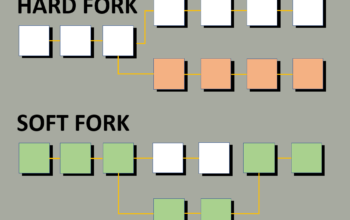
A hard fork is a radical change to the protocol of a blockchain network that results in the creation of two separate versions of the network. After a hard fork has taken place, the two versions of the network are no longer compatible with each other, and blocks and transactions that were previously valid on the old version of the network may no longer be valid on the new version.
An example of a hard fork in blockchain is the split of the original Bitcoin blockchain into Bitcoin and Bitcoin Cash in 2017. This hard fork was a result of a disagreement within the Bitcoin community about the best way to scale the network to handle increasing demand for transactions.
A soft fork, on the other hand, is a change to the protocol of a blockchain network that is backwards compatible. This means that after a soft fork has taken place, the new version of the network can still validate and process blocks and transactions that were valid on the old version of the network.
An example of a soft fork in blockchain is the change in the consensus algorithm of the Ethereum network from proof-of-work (PoW) to proof-of-stake (PoS). This change was implemented as a soft fork, which allowed the new version of the Ethereum network to still validate and process blocks and transactions that were valid on the old version of the network.
The main difference between hard forks and soft forks is the level of compatibility between the old and new versions of the network after the change has taken place. Hard forks are more disruptive, as they result in the creation of two separate versions of the network that are not compatible with each other, while soft forks are less disruptive, as they allow the new version of the network to still validate and process blocks and transactions that were valid on the old version of the network.
Additionally, hard forks can have a significant impact on the value of a cryptocurrency, as they can result in a split in the community and reduced liquidity for both versions of the cryptocurrency. Soft forks, on the other hand, typically have a much smaller impact on the value of a cryptocurrency, as they are less disruptive and do not result in the creation of a new cryptocurrency.
In conclusion, hard forks and soft forks are two different types of changes to a blockchain network’s underlying protocol. Hard forks are radical changes that result in the creation of two separate versions of the network that are not compatible with each other, while soft forks are less disruptive changes that allow the new version of the network to still validate and process blocks and transactions that were valid on the old version of the network. The choice between a hard fork and a soft fork can depend on various factors, including the reason for the change, the level of support within the community, and the potential consequences for the network and its users.