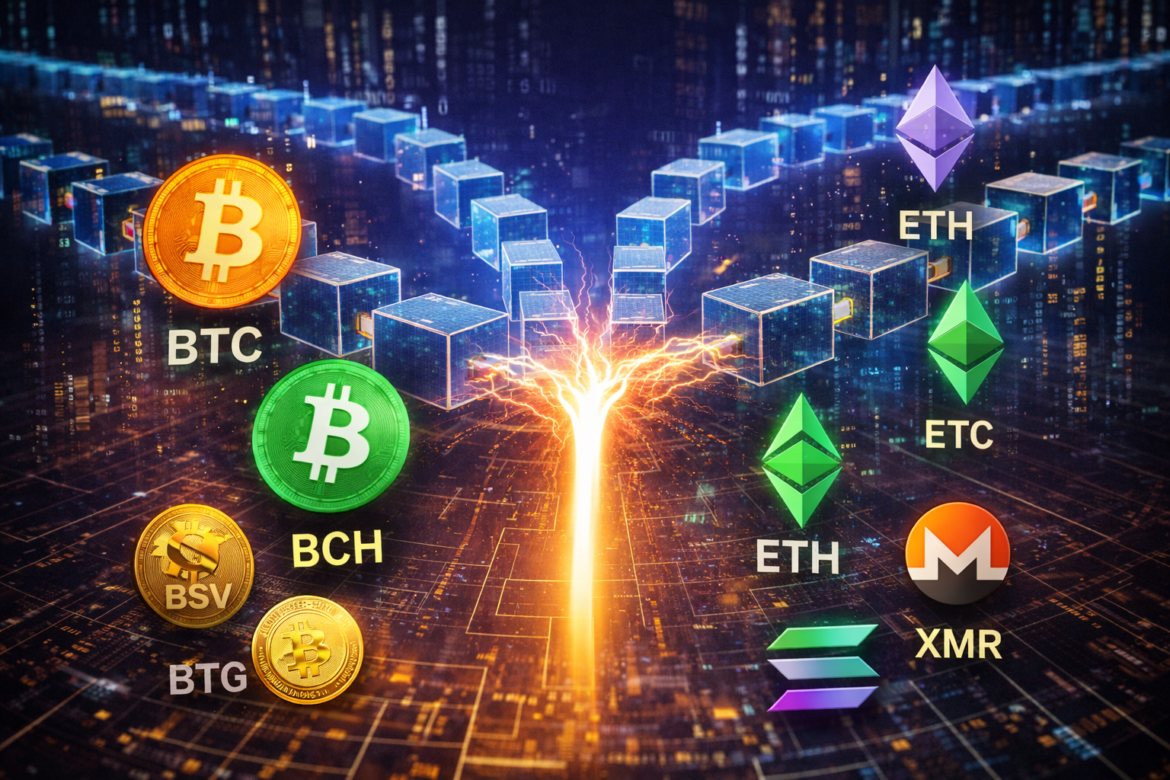
Hey there, crypto curious! Ever wondered why there are thousands of cryptocurrencies out there instead of just Bitcoin? Hard forks are like the rebellious siblings of the blockchain world—they split off and create new paths, sparking a ton of variety in our digital money playground. Let’s dive in and unpack how these splits make the crypto ecosystem way more diverse and exciting, step by step.
What Exactly Is a Hard Fork?
Picture this: You’re at a family dinner, and everyone agrees on pizza… until someone insists on pineapple. Boom—half the table grabs forks and starts a new meal with a fresh pie. That’s a hard fork in crypto terms!
A hard fork happens when a blockchain’s rules get a major upgrade that isn’t backward compatible. Nodes (computers running the network) must choose: upgrade to the new software or stick with the old one. This creates two separate blockchains from the same point in history. The original chain keeps chugging along, while the new one zooms off with fresh features.
Unlike soft forks (friendly tweaks everyone can ignore), hard forks are all-in. They’re permanent splits unless the community magically reunites—which rarely happens. Think of it as a divorce that births two families, each evolving on their own. This simple act of divergence is the seed for diversification, letting ideas that couldn’t coexist in one chain flourish separately.
Why does this matter? Without hard forks, blockchains might stagnate under endless debates. Forks let innovators test wild ideas safely, growing the ecosystem like branches on a tree.
Real-World Examples: Hard Forks That Shook Things Up
Nothing drives the point home like stories from the trenches. Hard forks have created some of crypto’s biggest names, each adding unique flavors to the mix.
Take Bitcoin Cash (BCH), born from Bitcoin’s 2017 hard fork. Bitcoiners argued over block size—Bitcoin’s 1MB limit caused high fees and slow transactions. BCH said, “Let’s supersize to 8MB (now even bigger)!” It kept Bitcoin’s history but prioritized speed for everyday payments. Result? A coin tailored for coffee buys, not just HODLing.
Then there’s Ethereum Classic (ETC). In 2016, hackers drained millions from The DAO project on Ethereum. The community hard forked to rewind time and refund users, creating Ethereum (ETH). Those who hated “rewriting history” stuck with ETC, valuing immutable code above all. Today, ETH powers DeFi and NFTs, while ETC flies the purist flag—two visions, one ecosystem boost.
Don’t forget Bitcoin Gold (BTG). Miners dominated Bitcoin with fancy ASIC machines, centralizing power. BTG forked in 2017 to use GPU mining (your gaming rig could join!), making it more accessible. Or Bitcoin SV (BSV), which cranks blocks to insane sizes for enterprise data. These forks aren’t just clones; they tweak mining, speed, or philosophy, giving users choices galore.
Each fork inherits the original’s tech but remixes it. Developers fork codebases cheaply, launching altcoins with niche perks. Over 100 Bitcoin forks exist, from privacy-focused ones to speed demons. This proliferation turns a single idea (Bitcoin) into a buffet of options.
How Hard Forks Spark Innovation and Choices
Hard forks aren’t just drama—they’re innovation engines. Here’s how they diversify the ecosystem in fun, practical ways.
- First, experimentation without risk. Can’t agree on scaling? Fork and test! Bitcoin Cash tried bigger blocks; others like Bitcoin Lightning (layer 2) stayed true. Both paths succeed, letting the market pick winners. No fork, no bold tests—stale chains ahead.
- Second, community-driven evolution. Crypto’s decentralized, so disagreements happen. Forks let factions pursue dreams: speed (BCH), immutability (ETC), decentralization (BTG). This “governance by fork” creates tailored chains for different needs—payments, smart contracts, data storage.
- Third, new use cases bloom. Forks birth specialized coins. Ethereum’s forks explore proof-of-stake tweaks; others add privacy (Monero-style forks). Users get options: fast/cheap (Solana-like forks), secure/established (Bitcoin forks), or experimental (DeFi forks). Competition heats up, pushing everyone to improve.
Economically, forks multiply assets. A Bitcoin hard fork gives holders free coins from the new chain—double the fun! This incentivizes forking, flooding the market with variety. Today, altcoins from forks dominate trading volume, proving diversification’s power.
But wait—diversification isn’t chaos. Forks force projects to earn loyalty through real utility. Weak ones fade; strong ones thrive, like natural selection for blockchains.
The Bigger Picture: Pros, Cons, and Ecosystem Growth
Hard forks supercharge diversification, but they’re not perfect. Let’s weigh it light-heartedly.
Pros galore:
- More choices for everyone. Want low fees? Bigger blocks. Privacy? Forked anonymity. The ecosystem explodes from monoculture to rainforest.
- Boosts competition. Forks pressure originals to innovate—Bitcoin got SegWit post-BCH fork.
- Resolves deadlocks. No more endless fights; split and prosper.
- Altcoin explosion. Forks created 60%+ of top altcoins, per history, turning Bitcoin’s spark into thousands of flames.
A few hiccups:
- Fragmented security. New chains start weaker, prone to 51% attacks (early BCH woes).
- Community splits. Loyalty divides, slowing growth sometimes.
- Market confusion. Too many “Bitcoins” baffle newbies.
Yet, the wins outweigh woes. Hard forks turned a $0 crypto scene into a trillion-dollar ecosystem. They enable niche chains: gaming (forked EVMs), supply chain (enterprise forks), even memes with utility. Without them, we’d have fewer DeFi apps, NFTs, or Web3 dreams.
Looking ahead, forks evolve. Tools like snapshot voting reduce splits, but expect more as tech advances—quantum resistance, anyone?
Why This Matters for You, Crypto Explorer
Hard forks democratize crypto creation. Anyone with code skills can fork, tweak, and launch—low barrier, high reward. For investors, it’s opportunity: spot forks early for gains. Users? Pick chains matching your vibe—fast, private, or battle-tested.
In short, hard forks diversify by splitting chains into specialized siblings, fostering innovation, competition, and choices. They’re the ecosystem’s secret sauce, turning one blockchain into a vibrant universe. Next time you swap BTC for BCH or ETH, thank a fork!